


Sign up for Chalkbeat Detroit’s free newsletter to keep up with the city’s public school system and Michigan education policy. Sign up for their newsletters.
The Detroit school district will close four schools at the end of this school year, officials confirmed Wednesday.
All four schools – Ann Arbor Trail Magnet School, J.E. Clark Preparatory Academy, Catherine Blackwell Institute, and Greenfield Union Elementary-Middle School – had previously been identified to be phased out in 2022 by the Detroit Public Schools Community District due to low enrollment and high operation costs.
District officials originally planned to stop enrolling new students at the schools, phasing out grades over time to minimize disruption to families. But Superintendent Nikolai Vitti indicated during Tuesday’s board meeting that the plan had changed because of budgetary concerns.
“When we looked at the budget and the threats at the federal level, increased inflation, need to continue to increase wages for all of our employees with an upcoming bargaining season, we said, how do we maximize our costs and still help children?” Vitti said. “And one way we did that was to accelerate the phase-out of the original phase-out schools.”
Vitti only mentioned one of the four schools during Tuesday’s meeting — Greenfield Union Elementary-Middle School. DPSCD spokesperson Chrystal Wilson confirmed to Chalkbeat on Wednesday that four schools, including that one, will close at the end of June. The last day of the school year is June 5.
District officials did not immediately respond to questions about when families were notified of the accelerated timeline for school closures.
Rudaina Kainaya, a middle school science teacher at Greenfield, told Chalkbeat the school’s principal shared the news of the closure last month during a staff meeting. Staff were told they will be placed in other district positions, she added.
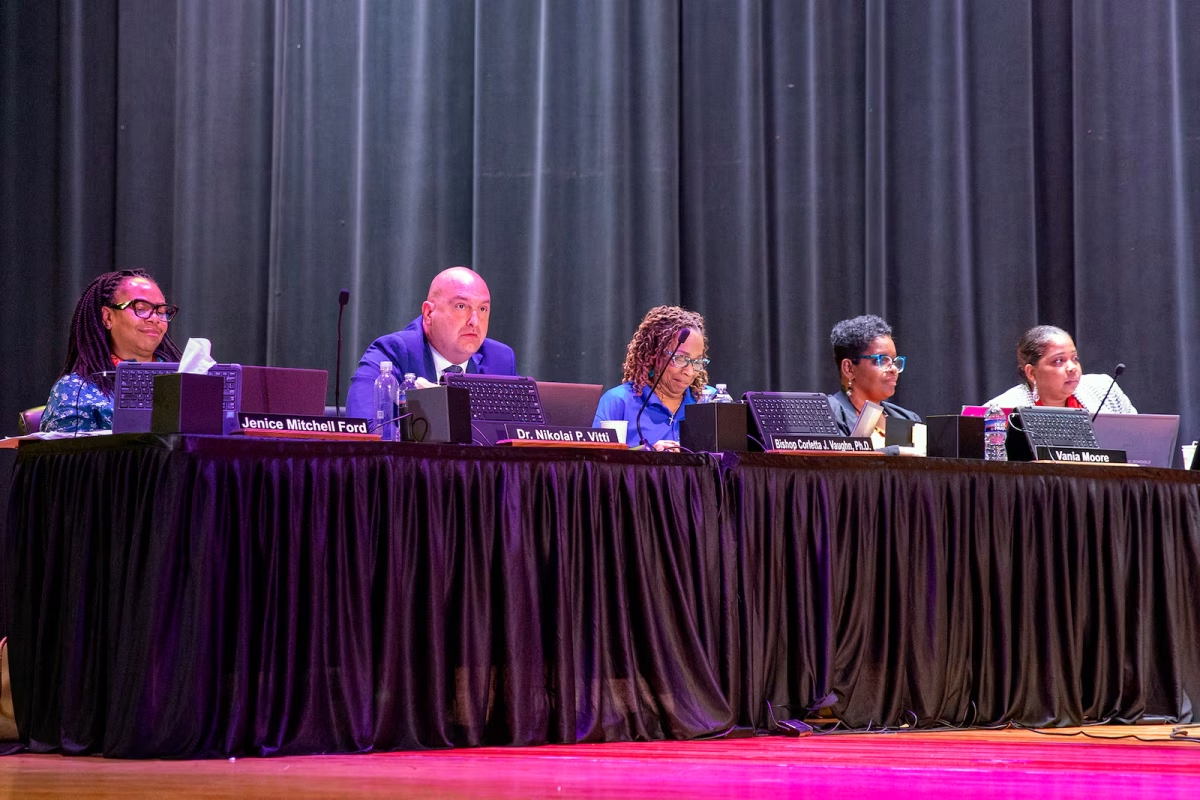
The board meeting Tuesday was marked by shouts of frustration from the crowd and a tense exchange between board members. Security circulated the auditorium at Renaissance High School to warn audience members to settle down. At one point, an officer appeared to ask a mother to leave but stopped at the direction of Board Chair LaTrice McClendon.
None of the schools were on the meeting agenda, but some of Greenfield’s teachers and parents showed up for the public comment portion of the meeting.
Kainaya, who spoke during public comment, said staff members at Greenfield were originally told the school would close one grade level at a time.
“Dr. Vitti said that even if we had 10 students left [per grade] at that time in 2022 and 2023, they would phase out that last year for those students as eighth graders,” she said.
Vitti said the district did stick to that promise for the higher grades at Greenfield and has given families time to move their children to other schools. He added that he was troubled by the public comment, because the closures have been discussed for several years.
“It’s disingenuous to come to the mic tonight and say we didn’t know the school was going to close,” he said.
But he acknowledged that the accelerated closure plan is new.

Mass school closures in the district — both before and after the state’s period of emergency management — enraged many families over the years and prompted some to abandon the school system.
In 2019, Vitti told Chalkbeat the district would not “replicate the sins of the past,” and he would take a different approach to closures than previous administrations.
“We would phase schools out and phase grade levels out rather than abruptly closing schools,” he said. “But part of this process has to be rightsizing the district. We have too many open seats.”
There are 15 other schools the district says cost more to keep open than the revenue they generate, according to a 2025 report.
“This is a districtwide challenge that is not going away,” Vitti said during Tuesday’s meeting.
Former board member LaMar Lemmons, and others who spoke during public comment, said school closures are a reflection of the district’s failure to grow enrollment.
Vitti said low enrollment is a long-term problem stemming in part from Detroit’s population decline and the fallout of the state’s emergency management of the district.
When emergency management ended, the district enrolled about 45,700 students. The numbers increased by more than 5,000 the following year when Vitti took the helm. However, enrollment declined during the COVID pandemic, and the district has not yet fully recovered its numbers.
At the beginning of the 2025-26 school year, there were around 49,400 students, state records show.
Community support for a charter school with an uncertain future
Dozens of community members also spoke during Tuesday’s meeting to urge board members to renew a one-year contract for Barack Obama Leadership Academy.
Four board members, who were present during a committee meeting last month, decided not to put a vote on the Obama charter on the agenda for Tuesday’s meeting – a move that likely means the charter would not be approved by the district to operate for another year. At the time, some members said the charter had received multiple warnings that it needed to improve its academic performance and had not shown enough growth.
If the board does not approve a new contract by June 30, the charter will either have to rush to find a new authorizer or face closure.
Michigan charters must sign a contract with an outside body, known as an authorizer, in order to operate. DPSCD, like other school districts, colleges, and universities, can serve as an authorizer. Its role is to monitor the schools’ compliance with education laws.
The district currently authorizes six charters, excluding the Obama school. One more is expected to open in the fall.
Cha-Rhonda Edgerson, CEO of the charter, said during Tuesday’s meeting that the school wanted a final one-year contract with DPSCD to allow enough time to find a new authorizer.
“This is not a request to reverse the course indefinitely,” she said. “We’re asking for the opportunity to continue serving our students while we complete that transition in a thoughtful and structured way.”
During public comment, Tiffany Walls, a parent at the school, described the charter as a community hub and safe haven.
“A school is more than just a list of test scores,” she said. “It’s a vital pillar of the community.”
It is unclear whether the board will revisit the matter at its next committee meeting on April 29 or if it will be on the agenda of the regular board meeting on May 12.
A tense exchange among board members
At the start of the meeting, board member Ida Short asked to make changes to the agenda related to school closures and the Obama charter’s contract.
She said she wanted to “plan a way in which agenda items can be provided by individual board members, so that it does not matter who is the president or not the president, because we’re all equal members.”
McClendon, the board chair, said that “any board member at any time can add an agenda item.” She encouraged Short to attend the board’s committee meetings, where policy is discussed and agendas for regular board meetings are decided.
“I know you’ve missed the last two meetings, but that is the place where you can discuss [policy],” she said.
Short responded, “If I don’t attend any meeting, it means that I have something personal that’s very important.”
Later in the meeting, Short asked about another agenda item, and McClendon responded that the item was discussed at length during the last committee meeting, including the answer to Short’s question.
She suggested Short go back and listen to a recording of the committee meeting.
Hannah Dellinger covers Detroit schools for Chalkbeat Detroit. You can reach her at hdellinger@chalkbeat.org.
One of the huge missteps in the past has been that schools were left vacant and were stripped — leaving the community with abandoned structures as eyesores. What actions, if any, are on the table to convert empty schools to other uses? If none, what are the impediments to and possibilities of doing so?
Good and fair question, and food for thought. 💃🏽