



For Takiyah Pearson, the Barack Obama Leadership Academy has been an idyllic place to send her children, with its Afro-centric curriculum and family atmosphere.
But the charter school could close after this year, leaving her and other parents in a conundrum: Search for new schools now or take a wait-and-see approach that, if the school does close, could put them behind other parents also on the hunt.
“I am waiting every day,” Pearson said. “I want to know what’s going on now. I don’t want to wait until the last minute and find out they’re closing. It’s already stressful and very disheartening to know that this is even happening.”
As this school year comes to a close, some parents in Detroit are trying to find new schools for their children, navigating a complicated selection process that is often based on word of mouth and requires parents to learn about the plethora of educational options in the city. Parents and students are also grieving the loss of their current schools.
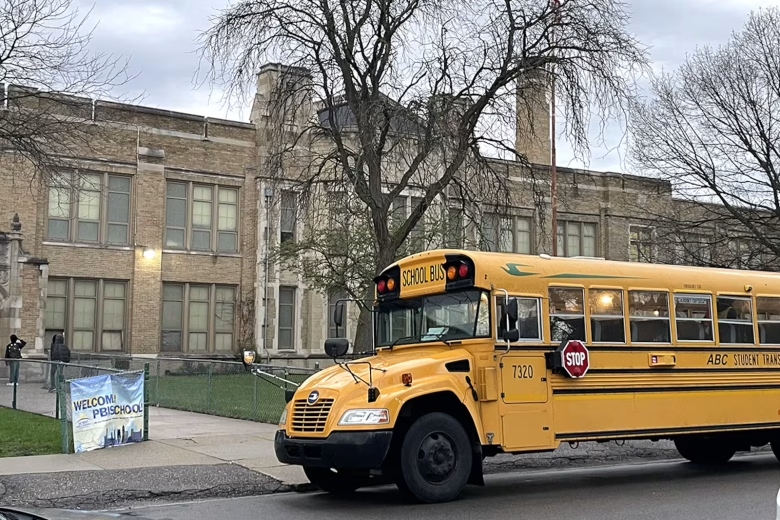
In addition to the uncertainty surrounding the Barack Obama Leadership Academy, which needs a new charter authorizer to stay open, four schools in the Detroit Public Schools Community District are set to close at the end of the school year. Students’ last day is Friday.
Those schools include Ann Arbor Trail Magnet Academy, Greenfield-Union Elementary-Middle School, Catherine C. Blackwell Institute, and J.E. Clark Preparatory Academy. A fifth school, Thurgood Marshall Elementary-Middle School, is slated for closure at the end of the 2026-27 school year.
The district first announced in 2022 that it would begin “phasing out” the schools, which meant not enrolling new students and eliminating grades over time. District officials decided last year, as part of the district’s budget, to accelerate the timeline, citing the high cost of maintaining buildings with so few students.
Despite the advance notice these parents had, some are still weighing next steps for their children, whether that means enrolling them in the schools the district reassigned them to or finding new schools.
Marcus Langston is raising two granddaughters who were enrolled at Ann Arbor Trail, one an eighth grader who is moving on to Martin Luther King Jr. Senior High School and a fifth grader who is currently on a waitlist at the School at Marygrove.
Langston said he’s interested in Marygrove because it’s not too far from his home in Rosedale Park and he likes its extracurricular activities, including sports teams, arts clubs, and robotics. He also has heard positive things about the support available to students, such as counseling and mental health services.
“I just heard it’s a good school with a lot of programs,” he said.
In the past, school closures in Detroit were traumatic
This year’s school closures mark the first time in more than a decade that this many schools have shut down in one year, but it is far short of the days when dozens of schools in Detroit would close each year.
Between 2000 and 2016, around 200 district schools closed because of low enrollment and budget deficits. During most of that time period, the district was under some form of state control.
Many of the decisions were made by emergency managers at the end of the school year, with little to no warning.
The closures were unsettling because of how attached students, staff, and families were to their schools, said Helena Lazo, the co-founder of education nonprofit 482Forward and a former Detroit district teacher and principal.
But it was a “complex situation,” she said, pointing to dramatic drops in the district’s enrollment over the years. In 2000, for instance, the district enrolled more than 160,000 students, compared to nearly 50,000 now. (The district has 72,000 available seats.)
School closures had some damaging consequences, as some parents fled the district and sent their children to one of the many charter schools in the city, or enrolled them in suburban school districts through Michigan’s Schools of Choice law.
Today, half of the school-age children in the city don’t attend district schools. Meanwhile, years of school closures left the city littered with vacant, abandoned school buildings. (The district has vowed to demolish the four schools that are closing.)
Concerns about enrollment persist, but under the current administration, the approach to closure decisions has been different. Superintendent Nikolai Vitti told Chalkbeat in 2019 that he didn’t want to “replicate the sins” of district leaders who abruptly closed schools without listening to the community.
“Ten years ago, school closures happened a lot more frequently, and they would just lock the door and be like, ‘Good luck to you,’” said Maria Montoya, a Detroit parent and education consultant who has worked with schools in Michigan and nationwide on issues such as enrollment. “You might not even get any of your child’s things back. But what’s evolved for this is the fact that they’re telling people, ‘This is how you’ll get your placement and you will have this transportation.’”
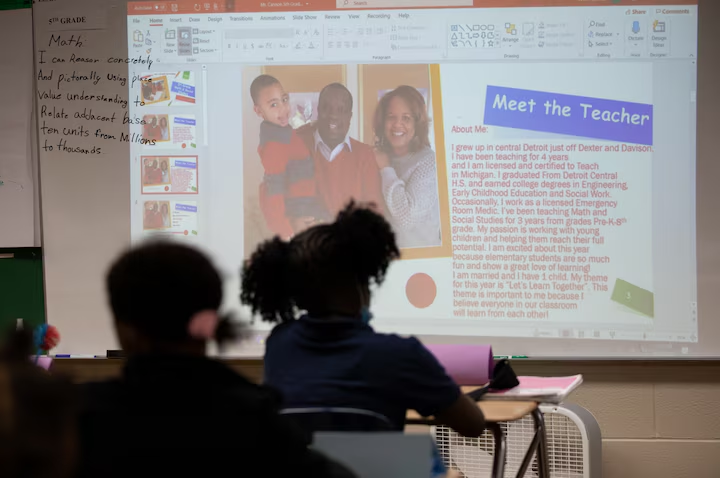
Lazo said she appreciated how the district handled this year’s school closures, especially that families were sent letters regarding the accelerated timeline, and students will have transportation to their new assigned school next year. But she thinks more engagement with families was needed.
“There’s always room for improvement,” she said.
What’s the future of closed DPSCD buildings?
The Detroit Public Schools Community District is holding four community engagement sessions over the next two weeks at four schools that are closing after being phased out for several years.
During the engagement sessions, school officials will discuss school phase-outs, demolition plans for the buildings, and future plans for the sites.
Here is info on when and where the sessions will be held:
- 4 p.m. Monday (June 8) at Greenfield Union Elementary-Middle School, 420 W. 7 Mile.
- 4 p.m. Tuesday (June 9) at Ann Arbor Trail Magnet School, 7635 Chatham.
- 4 p.m. June 15 at Catherine C. Blackwell Institute, 9330 Shoemaker.
- 4 p.m. June 16, J.E. Clark Preparatory Academy, 15755 Bremen
Families grieve loss of closed schools
Trying to navigate the complicated process of finding a new school is difficult enough. But when schools close, many of those involved — children, parents, staff — go through a grieving process, Montoya said.
“Even if you’ve only been there (at a school) for one year or if you’ve been there for three, four years, there’s some sort of grieving process,” she said.
Tiffany Walls, whose daughter, a fifth grader, has attended the Obama charter since kindergarten, is still shocked that the school might close. Her father also went there, when it was called Timbuktu Academy of Science and Technology (the school name changed in 2020).
Even as her own life shifted — she lived for some time in Pontiac, then moved to Detroit’s west side — she kept driving her daughter to the school.
“I was dedicated to keeping her in some stability,” she said. “Although I moved, I didn’t want to keep switching schools with her.”
She isn’t sure what to do about her daughter’s placement for next year.
“I’m a part of this community, and just to take that away would be devastating, not only to me but to her too,” she said.
Cha-Rhonda Edgerson, CEO of the charter school, said school officials are trying to secure a new authorizer. She said they are under review with one, but it could be mid-August before that authorizer makes a decision.
“We are pushing forward and hopeful,” she said.
Many families are hopeful the school will stay open despite the uncertainty, she said.
Because parents are grieving, they may wait until July or August to select a new school for their children, Montoya said, but families should create a plan as soon as possible.
Adero Jenkins is among the parents who haven’t made a decision yet.
When her daughter Amara was in first grade, Jenkins enrolled her in Ann Arbor Trail, a school she attended in the late 1990s when it was solely a middle school. With the school’s closure, Jenkins is disappointed that her daughter, now in sixth grade, won’t graduate from Ann Arbor Trail like she did.
Extracurricular options are an important factor in the decision – Amara played volleyball and did theater at Ann Arbor Trail, and she wants her to continue those activities.
Jenkins said she is expecting some recommendations from the district’s enrollment team. Wherever she goes, Jenkins told Amara to keep an “open mind.”
“Hopefully it’ll be a smooth transition,” she said.
Chalkbeat bureau chief Lori Higgins and reporter Hannah Dellinger contributed to this report.
Micah Walker is a reporter for BridgeDetroit. You can reach her at mwalker@bridgedetroit.com.
Laurie Mermet is a freelance reporter for Chalkbeat Detroit.