

This story was originally published by Chalkbeat. Sign up for their newsletters at ckbe.at/newsletters.

This year, the Detroit district is sending a stronger message to parents that their children must remain in class the entire school day.
The Detroit Public Schools Community District wants to curb unexcused early sign-outs, defined by administrators as instances in which parents pick up their children before the school day ends without documentation showing it is necessary, such as a doctor’s appointment.
Starting this school year, parents who repeatedly unnecessarily take their kids out of school early will have to attend meetings and sign attendance contracts.
“Principals and teachers have repeatedly asked Central Office to establish clearer guidelines for stronger and more uniformed communication and accountability for this challenge, so they are not constantly at odds with parents regarding early pickups,” Superintendent Nikolai Vitti told Chalkbeat in an email.
Sign-outs disrupt learning for students who leave early and their peers, Vitti said. When a student is signed out early, teachers may be notified with phone calls to their classroom or announcements over school speaker systems. Sometimes administrators have to abandon other work to get students, and security officers must screen all adults who enter schools for pickups.
Some of the most common documented reasons for early sign-outs in the district are the same that cause chronic absenteeism: parents and students’ inflexible work schedules, inadequate childcare, poor health, a lack of access to reliable transportation, and unsafe routes to school.
“To be clear, parents should always work with the school about safety concerns so intervention can occur between students and families,” Vitti said.
But some parents don’t give an explanation, while others tell the staff they simply don’t like waiting in the pickup line, Vitti said.
DPSCD’s new policy
The district’s previous policy only discouraged early sign-outs.
Early pickups may now happen only on “rare occurrences” and require documentation, such as proof of an appointment, the newly adopted policy says. Early releases outside of documented emergencies are now prohibited within the final 30 minutes of the school day. A typical elementary and middle school day lasts around seven hours.
Students will also be marked absent from class if they miss more than half of the instructional period.
The policy mandates parent meetings when students have three or more unexcused early sign-outs in a quarter. During the meetings, administrators will discuss the impact of the early departures and what instruction the students have missed. School staff will determine the issues causing students to leave before the final bell and connect families with additional resources.
Parents will have to sign attendance contracts — formal agreements to follow attendance policies — if their children have six or more unexcused early departures in a quarter. Parents will be asked to agree that their child will check in and -out with an attendance agent or other staff member.
“If the family does not comply with the contract, and continues to miss periods of the school day, then those absences continue to add up and contribute to the overall chronic absenteeism numbers for the student,” Vitti said.
There already are consequences for students who miss too many days, such as making them return to their neighborhood schools, referring them to the Wayne County Prosecutor support program, or requiring them to repeat their current grade.
More research is needed on solutions to partial-day absenteeism
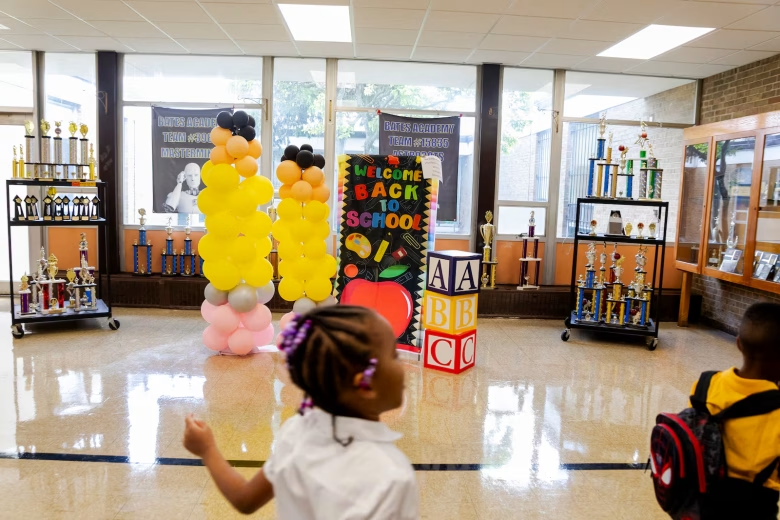
By 3:10 p.m. Wednesday, dozens of cars lined both sides of Pembroke Avenue outside Bates Academy on the city’s north end.
In one car, father Terry Thomas waited about 45 minutes to pick up his seventh grader. He said he doesn’t believe it’s fair for parents to pull children out of class early for their convenience.
“They should finish the day; it’s a school day,” he said.
Other parents in the pickup line agreed, saying their children are taught until the final bell.
Some parents said they have sympathy for families facing socioeconomic barriers that contribute to absenteeism. One mother said it’s not always possible to schedule necessary medical appointments outside of school hours.
On social media, multiple parents shared concerns with Chalkbeat about unintended consequences of the policy for students with disabilities, including those who leave early due to behavioral or mental health reasons.
One parent said protecting instructional time is reasonable but shouldn’t be enforced through punitive measures. Many said they thought the policy is a positive change that will result in fewer students leaving early.
There is limited research on partial-day absenteeism, leaving gaps in understanding its root causes and potential solutions.
Early sign-outs happen across the district’s schools and at all grade levels, according to DPSCD.
The district is highlighting the problem in the same way it has elevated concerns about the long-term harms of chronic absenteeism.
In recent years, DPSCD has made progress reducing chronic absenteeism, defined as a student missing 18 or more days of a typical 180-day school year. Those efforts have included educating parents about how absences can cause their children to fall behind grade level and how they might struggle for years to catch up.
Similarly, departing class before lessons are finished —– or partial school day absenteeism –— can mean students miss essential instructional time. Studies show more instructional time generally produces better academic performance.
Hannah Dellinger covers Detroit schools for Chalkbeat Detroit. You can reach her at hdellinger@chalkbeat.org.
Chalkbeat is a nonprofit news site covering educational change in public schools.
Thanks for this article. Absenteeism isn’t a new issue and, as your reporting confirms, there’s been insufficient research to identify and address the root cause issues. Rather than meeting with parents to identify the real issues, the “solutions” are “rewarding” perfect attendance and requiring parents to sign “contracts” that inflexible work schedules, lack of affordable childcare, lack of transportation, housing insecurity and other realities make it difficult if not impossible to comply with.
I continue to believe most parents want the best for their children so they can have better lives, and that should be the school systems’ goal, too. Let’s find real solutions that would help achieve that goal.