
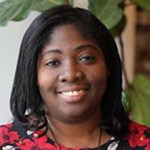

Even though Shavonne Coleman has been in the theater world for years–acting, writing and directing in youth and community productions in Michigan and across the country–she knew her latest project would be a new challenge.
The Detroiter made her professional directing debut with “Eclipsed,” which runs at the Detroit Repertory Theatre through May 17. The play is set in Liberia in 2003 during the end of the Second Liberian Civil War, a conflict that involved child soldiers and killed thousands of people.
While war stories usually follow the soldiers in battle, Eclipsed follows the lives of five women and their roles amidst the war. Helena and Bessie, also known as wives #1 and #3, are kidnapped and sexually assaulted by a commanding officer. The two watch over a teenager who is simply known as “The Girl,” as she becomes the officer’s latest target. The three women form a bond, living together in a shack while trying to survive.
Eclipsed was written by actress and playwright Danai Gurira, best known for her roles in “Black Panther” and “The Walking Dead.” The play debuted in 2009 at the Woolly Mammoth Theatre Company in Washington DC. In 2016, Eclipsed made its Broadway debut, with actress Lupita Nyong’o as part of the cast.

Coleman said she initially didn’t know much about the Second Liberian Civil War, which took place from 1999 to 2003 after a rebel group, Liberians United for Reconciliation and Democracy (LURD), began a military offensive seeking to overthrow then-President Charles Taylor. The war started two years after the First Liberian Civil War ended, which lasted from 1989 to 1997.
Coleman did extensive research on the two civil wars to prepare for her role as director, reading numerous articles and watching documentaries about the topic.
But Coleman doesn’t mind doing some homework. In addition to acting and directing, she is an assistant professor in the theatre and drama department at the University of Michigan. Coleman also works with Mosaic Youth Theatre of Detroit, where she helps adapt, write, direct and coach youth theater.
BridgeDetroit talked to Coleman about the accuracy and realism she wanted to bring to Eclipsed, working with actors making their professional debuts and taking care of the cast’s mental health.
Editor’s note: This transcript was lightly edited for length and clarity.
BridgeDetroit: Did you feel pressure taking on this play by Danai Gurira?
Coleman: There were times where I felt pressure and then there were times where I felt like I was exactly in the room I was supposed to be, doing what I was supposed to be doing.
While reading it, I had this moment of being like, ‘Yes, this is a story that needs to be told.’
In one of the documentaries, they (Liberians) kept bringing up how they thought America was coming to save them, as peacekeepers. They were waiting for us to come and most of us, as American people, didn’t even know it was happening. And if we did know it was happening, we didn’t know to what extent. And so, I felt the pressure because it was like, ‘This is such an important story to tell, and we should be paying attention to this story.’
There were times where I was like, ‘I don’t want to offend anybody.’ I’m not Liberian, so I want to feel like I’m telling the story well. But then, as a Black woman, I feel deeply connected and rooted in global blackness in the African diaspora. It was pressure and comfort at the same time.
BridgeDetroit: What was it like working with Shonique White and Danae Ross, who are making their professional acting debuts?
Coleman: I felt really lucky to have that ensemble of women, they were fantastic. Working with Danae and Shonique was great. Shonique was actually in (Detroit Repertory’s) Actors Workshop. Danae might have been too, but the time Shonique was in it, I taught at the Actors Workshop, so it was nice to come full circle and work on this production together. It’s so nice to bear witness to them having that journey of their first show, and to be able to ideate together about how you build characters. Also in the room, we had people in their 20s, 30s, 40s and 50s. It was nice to have women in different decades acting together. I feel like I learned so much and everybody else learned so much. We became sisters, we became our own little village.
BridgeDetroit: What did you and the cast do to take care of your mental health?
Coleman: One of our practices was around doing consent and accessibility check-ins at the beginning of every rehearsal. We also talked about how we individually checked in and out and folks picked their own way of doing that, sort of like separating their own experience from the experience of the play. We also had a conversation about once they moved into the theater and the show opened, and having a ritual as an ensemble. Also, myself and my stage manager, Michelle (Guernsey-McKay), were reading the room and asking questions. Sometimes, we could tell folks needed a minute, so we’ll have a 10 or 15-minute break.
It only happened once, but one night (during rehearsal), it got so heavy. I think we had an hour left, and I was like, ‘All right, let’s go home for tonight.’ You could just tell by everyone’s face and posture and energy in the room that it was a tough day. It helped us with our mental health, but it also helped with trust amongst each other.
BridgeDetroit: How did you get into theater? Was it something you were interested in as a kid?
Coleman: I started out doing glee club. But then, in the eighth grade, I auditioned for Mosaic Youth Theatre of Detroit and I ended up being in their outreach program that year. In ninth grade, I auditioned and got in. After that year I was like, ‘This is what I’m gonna do. Theater forever.’ A couple times in my adulthood, I changed my mind, but I always found my way back to theater. It was being in Mosaic Youth Theatre of Detroit that solidified it for me.
I went to Grand Valley State University for my bachelor’s in theater. After I returned (to Detroit) I started doing work in schools and after school programs. I discovered being a teaching artist and loved it.
In 2011, I went to grad school at Eastern Michigan University and there is where I got my MFA (Master of Fine Arts) in applied drama/theatre for the young. My mom and dad would always say, ‘Do something you love because no one likes working.’ I’m glad this is what I do. Sometimes it’s hard, but I love it and it’s fun. It always makes it worth it.
BridgeDetroit: What do you hope audiences take away from Eclipsed?
Coleman: One of the main things I hope folks take away is sort of like the “Beauty and the Beast” of humanness, the idea that we are different people and we’re going through different things. Some of us go through quite terrible and quite wonderful things. Sometimes we’re going through quite terrible and quite wonderful things at the same time.
Even though we have a lot of access to information and people, we still are very boxed off and segregated in what we know and understand. By connecting with this story, for me, it opened up my brain a little bit to say, ‘These are the things that’s possible.’ How do we push for a better existence? How do we help ourselves and other people thrive? That starts with acknowledging the different human experiences that are happening.