


A pre-pandemic survey that found nearly one in four Detroit students considered suicide weighs heavy on the mind of City Council President Pro Tem James Tate, who faces his own mental health struggles while working on ways to help others.
Results released in 2021 showed half of students surveyed experienced symptoms of anxiety or depression, which far exceeded national averages. Many of those surveyed experienced trauma and significant mental health concerns, and University of Michigan researchers concluded that Detroit children have unique mental health vulnerabilities.
Related:
- Program to connect youth with mental health services coming to Michigan
- New Detroit clinic aims to shape infant mental health
- Detroit agency launches mobile mental health unit. Can it slow a revolving door?
- Detroit adds mental health responders, neighborhood police with state funding
Tate is leading the “Protect Your Crown” awareness campaign, which focuses on promoting self-care and confronting the stigma associated with mental health issues. Tate’s office launched a community mental health survey this week to collect anonymous data on struggles Detroiters are dealing with.
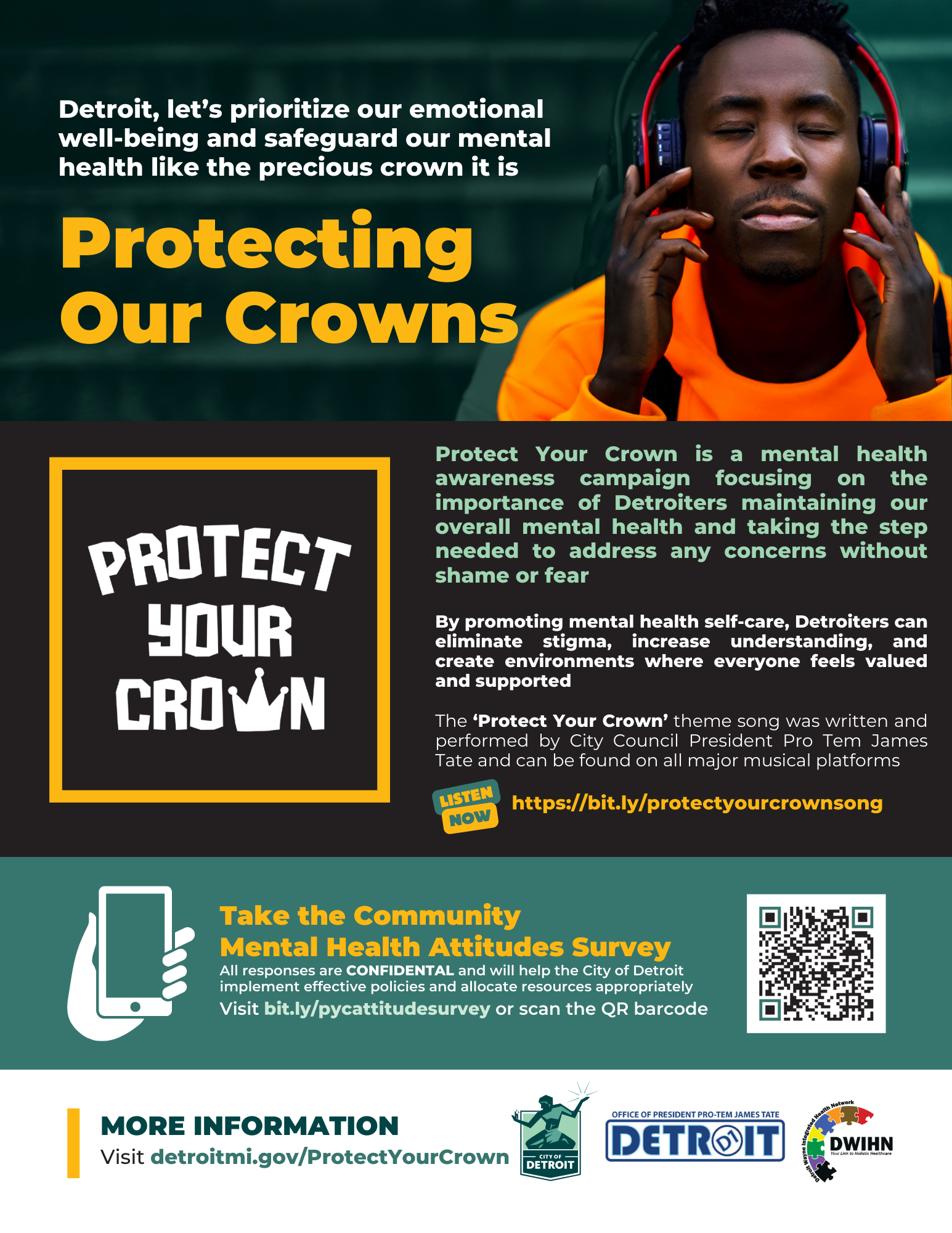
Tate is promoting the campaign with a rap single he composed and stars in. The soft-spoken and precise articulator in conversation confidently opens the song with rhymes about self-care.

The survey results will be used to shape policies and programs aimed at improving access to resources and creating safe environments for residents to feel supported. Tate said the goal is to collect 5,000 responses.
“Many times you hear residents have this thought that the city is just implementing programs and we’ll do something just to check the box,” Tate said. “It’s critically responsible for us to include residents so we can do more and know more. Those responses will reveal things that we did not have a true understanding of.”
The survey asks participants about their attitudes toward and relationship to mental health issues, including their own struggles, sources of mental stress, ways to manage crises and barriers to seeking help.
Tate said he was a supporter of state legislation signed into law this week that requires insurance providers to cover mental health and substance abuse treatment similarly to other health issues. Lawmakers representing Detroit – state Sens. Stephanie Chang, D-Detroit, and Erica Geiss, D-Taylor – were sponsors of the bill.
Tate is also backing a state House bill that bars insurance providers from cutting off mental health treatment. It was reported from a House committee last year but hasn’t received a vote yet.
“It is good practice to ensure any and all mental health treatments are exhausted before insurance companies refuse to pay for the rest of those treatments,” Tate said.
BridgeDetroit spoke with Tate about the awareness campaign and how the City Council can improve mental health care access in Detroit.
Editor’s note: This conversation has been slightly edited for length and clarity.
BridgeDetroit: What are the biggest barriers for people to receive treatment or address mental health issues?
Tate: Cost is certainly a challenge for folks. If you don’t have insurance you have to rely on Medicaid and there are rules there that (affect access to care).
Insurance that you have through your employer may only cover up to a certain amount of treatments. Some people don’t know that insurance covers mental health care and so they never inquire and they suffer in silence.
There is a long waiting period for many who are seeking these services. There is a need for additional mental health care workers. We’re going to be pushing and working with institutions to increase those numbers.
How do we increase the number of mental health care providers and workers that will be able to reduce the load?
There are some people who are turned away because there aren’t enough workers and others are told to get on a waiting list and have to wait long periods of time before they get assistance.
There’s many different reasons. The stigma of it (is another one). We’ve heard people don’t know where to start, who to reach out to, and when hit with a roadblock many folks will try to figure it out themselves.
BD: It is startling to see the severity of mental health issues among young people. Since the pandemic, it seems like things have gotten worse. How do we rise to the urgency of that?
Tate: I have mental health challenges, I have medication. I’m not afraid to say it. I have had a therapist.
COVID was something that changed me. I sat in a seat where people relied on me as a council member. At that time it was so dark. I was in a position to try and save the lives of hundreds of thousands in the city I represent while also trying to save my loved ones. That’s no different than anybody else, the scale may be larger, but that’s what we were faced with.
Many of us have not left that space. It was permanently imprinted, a sense of alert and anxiety that just doesn’t want to go away. We’re trying to figure out how to move it out of our system. We’re here today to figure this out collectively.
BD: Hearing more about your experience might be helpful for people with similar feelings. Can you share more about that?
Tate: I have anxiety. My triggers are literally that I want to be perfect and help people. I’m all in giving 100% and can’t close the gap and provide assistance because of varying reasons. It creates a sense of not being good enough, that I failed and am not worthy of the position.
I struggle through it, but what always helps is working with other people. When you have challenges, it weighs more than your successes. I’m able to help someone and accomplish something, the moment is fleeting. Our team keeps it moving. But when there’s something that doesn’t work out, it seems to sit there and get heavier.
Those moments where I try and I can’t seem to accomplish something for my constituents, those are the things that seem to drag me down. It creates heart palpitations, high blood pressure. Mental health affects your physical health.
I’m pushing through to do everything I can to help residents find avenues for their mental health treatments.
BD: Tell us more about the song and how it came together.
Tate: There’s nothing wrong with having fun. We get so heavy when we start talking about mental awareness. Sometimes it’s OK to just enjoy yourself.
I’m hopeful that others take the song and make it their own, putting their own lyrics to it.
A lot of folks who were born in the 70s and grew up in high school in the 90s and kind of dabbled a bit in hip hop. I’ve in the past had a rap group, I’ve done poetry, I’m very interested in the arts.
I have a lot of things in my mind that I want to do, from an artistic standpoint to help bridge the gap between civically-minded residents and those who are artistically free. There’s a way to blend it together, have fun and not rely on stiff press conferences.
I’m blessed to be the longest-serving council member at this moment. I don’t take that lightly. That means every year that goes by you have to reinvent the way you communicate with folks. The tools citizens use are evolving over time. The way the government communicates has to evolve.
I’m a little shy, but if I’m able to embarrass myself so to speak and get on the microphone and bring all the attention on me, I think that’s well worth it.
BD: Our reporting on mental health has largely been focused on what the police department is doing with their conflict de-escalation strategies and mental health co-response unit. Police are called when people hit their limit. Is this effort about creating new programs or policy changes to intervene sooner?
Tate: That’s the main reason we’re issuing this survey, because we only know what we think we know. We want to find out what challenges Detroiters are experiencing and not wait until the point where there’s a crisis, where you have a challenging situation to address and there may be an element of danger.
It’s important to normalize addressing mental health. Sometimes that simply means stepping away from everything on that particular day. It may not seem like you have the ability to do it.
It’s OK to slow down. It’s OK to pause, step away and regroup. The more you are doing and not stopping to assess your mental health, it’s not helpful.
BD: It will be interesting to see if the survey shows differences between youth and older people. We think about social media and internet culture affecting youth but mental health issues affect everyone.
Tate: You have adults dealing with things that happened when they were children and never got to address it – it’s called adverse childhood experiences.
When you learn to deal with stress by blowing up, intimidating others, you believe that’s how you survived. Survival is the primary goal of humans. When you have children, you can pass those traumatic traits on. It continues down that family tree. This is designed to bring awareness to childhood trauma.
The COVID-19 pandemic has certainly transformed a lot of folks’ minds. Because of the experience they had, there are people who are dealing with issues that are beyond their expertise to deal with by themselves.
Somebody needs to connect Councilman Tate with Kevin’s Song, a long-established and distinguished local organization focused on suicide prevention. He could be a powerful keynoter at Kevin’s Song’s next annual donor gala.
As someone who deals with mental health challenges myself, I’ve found creative outlets like music crucial for my well-being. Using his platform for the “Protect Your Crown” campaign shows real dedication to breaking down stigma. I’ve personally found support in products like mullein leaf, which have been a game-changer for my mental health. Here’s hoping more initiatives like Tate’s can make a difference.