
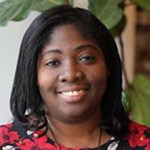

Two singers in Detroit Opera’s Resident Artist Program are set to take center stage in the organization’s upcoming production of a dystopian classic.
Travis Leon Williams and Brianna J. Robinson are among the leading performers in an operatic take on Margaret Atwood’s novel, “The Handmaid’s Tale.” The show premieres at the Detroit Opera House on Sunday, with additional shows on March 5 and March 7. Tickets start at $65, but Detroit residents can purchase two tickets for $25 each with a valid ID.
Like the book, the opera takes place in the totalitarian Republic of Gilead, formerly the United States, where women are forced into reproductive servitude called handmaids. Offred (played by Niamh O’Sullivan and Lisa Marie Rogali) is a handmaid for one of Gilead’s commanders (Sam Carl) and she fights to survive in her new environment. Williams plays Offred’s husband Luke.
BridgeDetroit talked to Williams and Robinson, who plays Offred’s friend Moira.
Williams and Robinson are two of four singers in Detroit Opera’s Resident Artist Program for the 2025-26 season, along with Mia Mandineau and Cole Bellamy. After an international search, the group was chosen from more than 800 artists around the world who applied to the program. Led by Detroit Opera’s head of music Nathalie Doucet, emerging artists receive vocal training, mentorship and opportunities to perform in the opera house’s productions.
The two talked with BridgeDetroit about their roles in “The Handmaid’s Tale,” how they prioritize their self-care and what led them to pursue opera.

BridgeDetroit: How is “The Handmaid’s Tale” opera different from the book and the TV show?
Robinson: In terms of the story, it’s the same. The thing that is the most different about it is just the medium in which it is being shown. With a book, you can turn a page and go back to a paragraph. In a TV show, you can press rewind if you miss something. In an opera, in live theater, you can’t do that. With the opera, the audience is receiving the information in a different way, maybe a way that’s more fleeting, and so, the attention has to be a bit more focused. The audience has to do their best to try and find those moments where the artists on stage are trying to do something with the text that they’re given, with the staging that they’re given. I love going to operas and seeing people and seeing the choices that they’re making and how it connects to what it is that they’re performing.
BridgeDetroit: Travis, what has it been like taking on the role of Luke?
Williams: Out of the male characters in the show, I think I have it pretty easy. Luke in the opera doesn’t exist in the time of Gilead, he is essentially a ghost of Offred’s past. You’ll see snippets of their life before, which I think provide some of the happier, more comedic points. There are a couple dark parts, obviously, but you get to see life with Luke and Offred with their child. He doesn’t go through the trials that Offred goes through, his future is left pretty open to interpretation.

BridgeDetroit: Brianna, what drew you to the role of Moria?
Robinson: Besides that they (Detroit Opera) asked me to do it, I actually was in “The Handmaid’s Tale” at Boston Lyric Opera in 2019. I covered the roles of Moira and Janine and I was also in the chorus. I remember really enjoying the role of Moira when I was covering it, seeing the character and how interesting she was and how different she was from everyone else who was in the show. I think that her character is so important to the fabric of the rest of the characters. I think she gives a lot of different characters hope. They see her connection to freedom and her connection to herself. All the characters talk about Moira when she is not even on the stage and I think that says a lot about who she is and how she presents herself to other people. I really enjoy the role. The music is very difficult, but that’s fun for me.
BridgeDetroit: How is it difficult?
Robinson: The music is very angular, very agile. You know the feeling of “The Handmaid’s Tale” and what a Gilead would really be, and I think he (composer Poul Ruders) really puts that in the music. It’s uncomfortable a lot of the time, the way that the music feels and sounds to your ear. In the show, there are gunshots, there are school bells. There’s a bunch of different things, and it can be a little bit uncomfortable. And the actual vocal music is kind of all over the place. It’s not necessarily melodic.
Williams: This is not an easy score to navigate. I talked about how Luke has some of the lighter moments character-wise. He has some of the lighter stuff musically, too. There are parts of the singing that are quite tonal, but there’s always something sneaky that’s thrown in there. It’s a horror movie score underneath operatic singing.
BridgeDetroit: How did you get into opera and theater?
Robinson: When I was three years old, I’m sure there are videos somewhere of me standing in front of the TV, dancing and singing to ‘90s R&B. Music has always been a part of my life. I went to a really incredible middle and high school in Ohio. I was in everything. I was in every ensemble, I was in every band. And during that time, I found out that I could go to school for music, like, I could do that for my job. And that’s what I did. I went to school, went to undergrad for music performance and continued on, and here today, as an opera singer.
Williams: My mother enrolled me in dance classes when I was three. I have a younger brother, and she wanted us to be as well-rounded as we could be. We both played sports growing up, and were required to take piano lessons and required to dance for a long time. My brother found his love and passion in football and sports, and I found mine in the arts. So I danced as a kid, I played piano from kindergarten through my sophomore year of high school, and then switched to organ for a couple of years. I loved being in the church Christmas pageants and being in the little elementary school plays that we did, and that translated into high school, when I would do musicals and plays.
My love for opera began when my parents introduced me to the 1943 film version of “The Phantom of the Opera” starring Claude Rain, Nelson Eddie and Susanna Foster and I fell in love with that film and so I became more curious about that art form. When we’d go to the library as a little kid, I’d come out with a recording of “Carmen.” When I was old enough to be on YouTube, I would look up a lot of opera singers and follow their journeys. I ended up going to community college where I started voice lessons. Everything worked out the way it needed to. I met some of the best people in my life along that journey at Western (Michigan University), at the University of Nevada in Las Vegas, at LCC (Lansing Community College). I’ve picked up really good people in the unconventional path that I took to get to where I am.
BridgeDetroit: With the show being very heavy and exploring difficult topics, how do you take care of yourself after rehearsal?
Robinson: There is an after care and there’s a before care. The themes in the show are–and especially for people who have been through things that are similar to the things that they’re seeing and hearing–can be so difficult. There’s a part of me that I bring into a character, but there’s also a barrier that I have had to learn to grow. When I did this show in 2019, I did not have the same tools. I remember we walked into rehearsal one time and I cried and it was hard for me to get myself back to normal.
Now, I know to do things like have a slow morning, a good breakfast, a good talk with a friend or a family member before rehearsal, watching something that is nice or doesn’t require me to do a lot of thinking. Then at the end of rehearsal–I live just around the corner from the Opera House–I take my walk back home. I breathe. I think about different moments in rehearsal that maybe got me thinking about something that isn’t the best, but taking that time to think about it and not ignoring my feelings. That’s one of the biggest things that I’ve learned over the years when doing a performance that can be very emotional, is not hiding from whatever feelings come up.

Williams: Detroit Opera somehow managed to put a cast together that really acts like family. There’s a very sibling-like dynamic, where we all get along, we laugh. We spend a lot of time together, whether it’s going out to dinner after or grabbing a drink or going shopping, things like that. It’s made this process a lot easier, because you feel safe with the people that you have to do these awful things with. I have an intimate scene with Lisa (Marie Rogali), who plays Offred before Gilead, and she’s just a wonderful colleague. She’s very easy-going. And because we get along, it makes doing what we have to do easier.
BridgeDetroit: What do you hope audiences take away from these performances of “The Handmaid’s Tale?”
Robinson: I hope that everyone who comes to see the opera sees the parallels in what’s happening in the opera to what’s happening in our own world. Art brings things to the forefront in a way that news does not. News can feel very separate from you as an individual, something that’s far away. Art and music, it’s there with you in the moment. It shoots through you when you’re sitting there and you’re seeing something that you’ve never seen before or that you’ve never thought of. I hope that particularly, playing my character, Moira, that it sparks something in people that says, “I’m going to fight for what I know is right. I want to look around me and see my community and work against the things that are trying to turn us against one another.”
Williams: The show is described as a cautionary tale, and it’s described that way for good reason. It’s very much an idea of what can happen if we lose the identity of what this country is supposed to be. This is supposed to be a country in which you could come from any corner of the world, speak any language, and you can still be an American. I hope that people walk away from the show wanting to have conversations, because this isn’t a piece that makes you feel happy in the end. This isn’t a piece that’s going to send you out the door, toe tapping and singing in your car. It’s a very beautiful, haunting piece of music. I want it to leave an impact of, “Where are we heading in this world? What happens when we stop seeing each other’s humanity? What happens when we stop fighting for diversity and for each other’s rights and freedoms?”