

This story was originally published by Chalkbeat. Sign up for their newsletters at ckbe.at/newsletters.

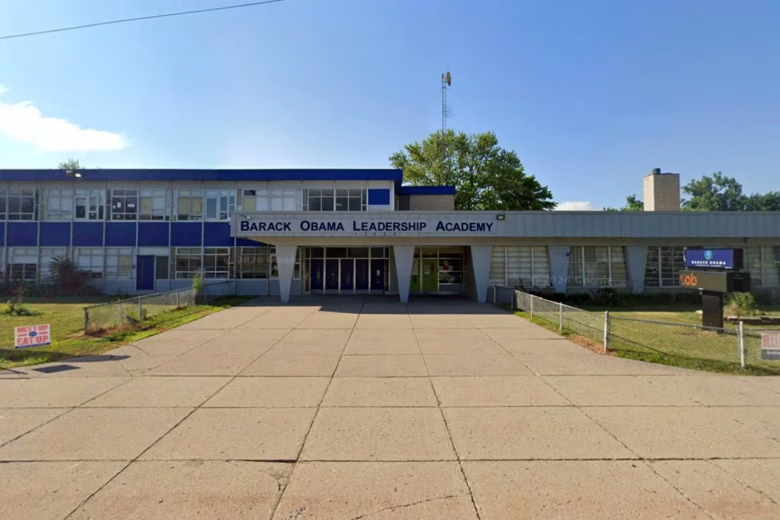
One of Michigan’s oldest charter schools, Barack Obama Leadership Academy, will likely not be approved by the Detroit school district to operate for another year.
At a committee meeting Wednesday night, administrators from the Detroit Public Schools Community District recommended that the school board approve a one-year contract for the school, which would allow it to either make plans to close or find a new authorizer. But board members, who are frustrated with the charter’s struggling academic performance, said the school had not shown enough improvement to continue through the 2026-27 school year.
The charter’s current contract ends June 30.
“The improvement is sad,” Board member Bessie Harris said during the meeting, referencing the assigned school grade given to the charter by the district. “From an F to a D – that’s not an improvement.”
The four board members who were present at the end of the committee meeting decided not to put a vote on the charter’s contract renewal on the agenda of the April board meeting – a move that signaled the body will not allow the district to authorize another year of operation.
Cha-Rhonda Edgerson, CEO of the charter, described the board’s decision as “devastating.” She said it also would give the school, students, and families very little time to make other plans. She described the school as a “pillar in that community.”
She also chastised board members for making the decision without a full board present.
Of the seven board members, Harris, Vice Chair Corletta Vaughn, Chair LaTrice McClendon, and Steve Bland Jr. were present for the discussion about the charter. Monique Bryant left the meeting early. Iris Taylor and Ida Carol Simmons-Short were absent.
Harris, Vaughn, and McClendon each said during the meeting that they were not interested in voting on whether to renew the charter’s contract.
Superintendent Nikolai Vitti said the one-year recommendation was meant only to give the charter a “transitionary year” to find another authorizer or prepare to close. “That’s up to the charter,” he said.
Edgerson did not immediately respond to questions Thursday about whether the charter will seek another authorizer.
Formerly known as Timbuktu Academy, the school offers African-centric education to about 300 students in grades K-5. The school has been open since 1997 on the east side of Detroit.
DPSCD – like other Michigan school districts, community colleges, and universities – can authorize charters. In exchange for monitoring the schools’ compliance with state and federal education laws, authorizers can earn up to 3% of the funding the state gives to charters, also known as public school academies.
The discussion around the Obama academy comes weeks after the Detroit board began navigating its future plans for the district’s relationship with charters. In a February meeting, board members said they want district-authorized charters to meet or exceed the academic achievement in district schools.
The district currently authorizes seven charters, including the Obama school, with one more charter expected to open in the fall.
More than half of Detroit’s school-age children go to charters. There were 81 city charters last year.
Small academic gains were not enough for the board
The Obama charter has long struggled academically.
Last year, DPSCD approved a one-year contract with the Obama charter with the condition it improve student achievement and the handling of its finances, as well as reduce chronic absenteeism. The district has given similar warnings to the charter since 2020.
In the 2024-25 school year, only 10.4% of students at the charter met benchmarks on state tests for reading and writing. In math, 2.8% met benchmarks. The numbers reflected a small margin of improvement from the previous year.
In DPSCD the same year, 15.4% of students in the same grades tested at or above proficiency for reading and writing and 12.3% in math.
The charter also reduced chronic absenteeism to 62.2% last year – a reduction of 2.1 percentage points compared to the previous year.
The chronic absenteeism rate was 60.9% last school year in DPSCD.
In December, the charter was released from its “partnership agreement” – a three-year contract that districts make with the Michigan Department of Education to rapidly improve – because it needed testing proficiency gains.
As part of efforts to improve, the charter has taken a number of steps.
It hired a full-time data coach and stepped up professional development for staff, according to DPSCD. It also made a plan to address its debt with the MDE, and the charter reduced staffing to align with its budget.
Though the charter showed improvement, it still did not meet the performance standards of district schools in the same neighborhood or those with African-centered curriculums, according to DPSCD.
Vaughn, the vice chair, said despite years of warnings, the school has “never, ever been able to come up.”
Hannah Dellinger covers Detroit schools for Chalkbeat Detroit. You can reach her at hdellinger@chalkbeat.org.
Chalkbeat is a nonprofit news site covering educational change in public schools.
Helpful read. The part about checking the details carefully was especially important.